Showing posts with label Part 2: Elements of design. Show all posts

Thursday, 14 July 2011

Rhythm & Pattern

This refers to large numbers of design elements massed together with repetition being the order to the grouping.

Repetition has a very strong appeal and visually it comes across in two ways: as rhythm and pattern. 

Rhythm is to do with movement across a picture - movement of the eye more specifically. 

Pattern is static and has to do with area. 

We could look at them as dynamic repetition and static repetition. 

Here are my examples of rhythm and pattern.


Rhythm
The viewer is able to see cars and more arches through the arches which creats a dynamic tension.

Pattern
The pattern fills the frame and gives the reader visual clues that there is more windows in this building

Shapes - Rectangles & Circles

Rectangles
These are more basic in terms of design as they relate to the shape of the picture frame. 

They occur more often as man-made than in nature eg buildings, windows and doorways.  They can be seen as less interesting than triangles as they require less imaginative effort.  The are static and there is less movement in shots that are simply divided by horizontal and vertical lines. 

They do, if you are using them, have to be precise as they won't look right if they are even slightly out. 

Here is an example of a rectangular shape in one of my images.


Circles
Depends on real circular objects which limits their use in photography.  It is the tightest and most compact shape of all though and imposes more structure on the image than any other shape.

Shapes - Triangles

Shapes are outlines and enclosures.  They can be regular or irregular.  Regular shapes you will find play a stronger role in composition than irregular ones as they are easily identifiable.

Shapes can also be implied like lines. 

Lighting plays an important role in the way shapes are defined.  It strengthens shapes and silhouettes through backlighting hide details of the subject making the outline more dominant.

Triangles occur more frequently than any other shape.  They always have at least 2 diagonals which gives movement to your images. 

Two sides is enough sometimes to show/form a triangle. 

Perspective also plays a big role in triangles in photography.  The tendency of linear perspective is for the lines to converge on a vanishing point in the distance. 

We can look at real and implied triangles.  Real triangles being things that are actually triangular in shape and implied things that form a triangular shape.

In this exercise I was asked to take a series of real and implied triangles. 

Real


Triangular subject


Triangle by perspective converging at top of frame

Triangle by perspective converging at bottom of frame

Implied

Triangular still life with apex at top

Triangular still life with apex at bottom

Sunday, 10 July 2011

Lines: Implied lines

The eye follows lines in composition.  Clear lines (like those we have looked at in the earlier exercises) provide the eye with a natural path to view. 

The eye also looks for imaginary lines when no obvious or clear lines are visible.  To do this the eye looks for visual clues:
  • a row of points
  • the extension of a line, or lines that seem to point in a certain direction allowing the eye to move ahead
  • the extension of visible movement, like a person walking or running this makes the eye move ahead
  • the direction a person in a picture is looking.  The viewer's eye tends to go to the same place.

These lines are called implied lines.  One of the uses of design in photography is organising a composition in a way that you want someone to look at it. Implied lines allow you to give clues to achieve this.

The implied lines are highligted in the 2 photographs below as per the workbook. 
The lines in these images are implied from the movement of the animals and the people in the shots.


I have identified implied lines in the following pictures I have taken in the past myself.


The last part of this exercise asked me to take a couple of shots with the following implied lines to lead the eye:
  • an eye line
  • the extension of a line, or lines that point

Eye lines


The extension of a line/lines that point


Thursday, 7 July 2011

Lines: Curves


Curves also have a sense of movement and direction.  They draw the eye in and are therefore useful in planned composition. 

Curves have a sense of elegance and smoothness and can add these feelings to our images. They are commonly seen in buildings but there are also less obviously curves too. For example, trees and flowers. 

Below are some images which use curves to emphasise movement and direction.


Water feature curves
This water feature shoots water a short distance into the air which provides little curve shapes. Because these curves are made of water they are ever moving. 

Curved building


Curved steps

Arches

Thursday, 30 June 2011

Lines: Diagonals

Diagonals are easy to create in a photograph.  They depend mainly on viewpoint.  There are few real diagonals - a staircase being one exception.  Diagonals depend on camera angle and perspective.

Straight edges will become diagonal in the picture if you photograph along them towards the distance.  They give a sense of depth and linear perspective is largely based on diagonals. 

Here are some examples of diagonals:


Wooden House
The diagonals are clear at the side of this wooden house shot at this angle.  The lines created by the wooden panels emphasises the diagonals and sense of movement.
Diagonal Building
This building has diagonal features.  This abstract shot highlights the diagonal by the angle it is taken from.

Trees
This row of trees shot at this angle provides a diagonal with depth of field. 

Bridge
The angle this bridge is taken from gives a diagonal giving a sense of movement into the shot.  The bridge design is also diagonal.  There is dynamic tension in the shot as the diagonal of the overhead wires is going in a different direction to the bridge.  

Wednesday, 29 June 2011

Lines: Horizontal and vertical lines

Contrast usually makes lines stand out.  Lines can be the edge of things but can also occur by implication where our imagination makes the connection between points. 

There are 3 types of lines:
  • horizontal
  • vertical
  • diagonal
Horizontal lines

Wooden bridge over the canal


Sheep in a field

Steps

Garage doors


Vertical lines

Old doorway


People waiting at a bus stop

Liverpool Street Station entrance


Vertical Statue


Points. Exercise 3: Multiple points

Moving on from the relationship between two points, this exercise focuses in the relationships with several points. 

Lines are implied by a group of objects creating shapes by implication.  The task is to create my own still life by rearranging the composition as opposed to changing the framing in the camera.  I used small leaves on a wooden background for this exercise.


One leaf


2 leaves and a single line is implied


3 leaves and a triangle shape is formed

4 leaves and the shape is square


5 leaves gives and a cruciform is implied


6 leaves and 2 shapes are forming

7 leaves form a triangle


8 leaves

8 leaves and a square and rectangle shape can be identified
The relationships in this final image are illustrated below:


Points. Exercise 2: The relationship between points

When there is more than one point in a picture the simplicity of a single point is lost. 

The relationship with one point is mainly with the frame as there is nothing else but with two points the relationships is between the points that dominate the image. When you look at the picture the eye is drawn from one point to the other setting up an implied line and direction in the picture.  Usually one point will attract more attention than the other because it may be bigger, appears nearer or is closer to the centre. 

In the pictures below the relationship between the points is illustrated. 


Your attention is drawn to the bird in the front because of positioning but also because of his colouring.  It is easier to see.

The relationship between these points illustrated by the blue arrow.

The relationship is between the 2 guys running.  The image is equally balanced and attention drawn to each runner. If one was ahead of the other our attention would be divided and focus on the runner closer to us.

The arrow illustrates the relationship between these points.


In this shot the attention is on the man nearest the foreground.  We can see what he is doing and he is looking into the shot whereas the other man is looking away.

The relationship between these points is highlighted by the blue arrow.

There is a special case where both points attract equal attention and thiscan be seen if you take a close up of someone's eyes where they are equidistant from the centre of the image as below. 


In this image we cannot resolve the composition and this leads to tension in the image. 

Thursday, 16 June 2011

Points. Exercise 1: Positioning a point

For this exercise I experimented with the different positions where you can position a point. 

There are 3 positions:
  • In the middle - although this produces a static image sometimes and in certain situations it can work
  • a little off centre - this makes the image a little more interesting
  • close to the edge

    
    Centre
    The centre position would be very static if it wasn't for the fact that the subject is on a bike cycling through the frame.  If he was posing/stationary then it would look static.  
    Off centre
    This works well for the rabbit as he is just off centre and gives more of a sense of movement and sense of being as his position is closer to the edge of the frame.  
    Close to edge

    
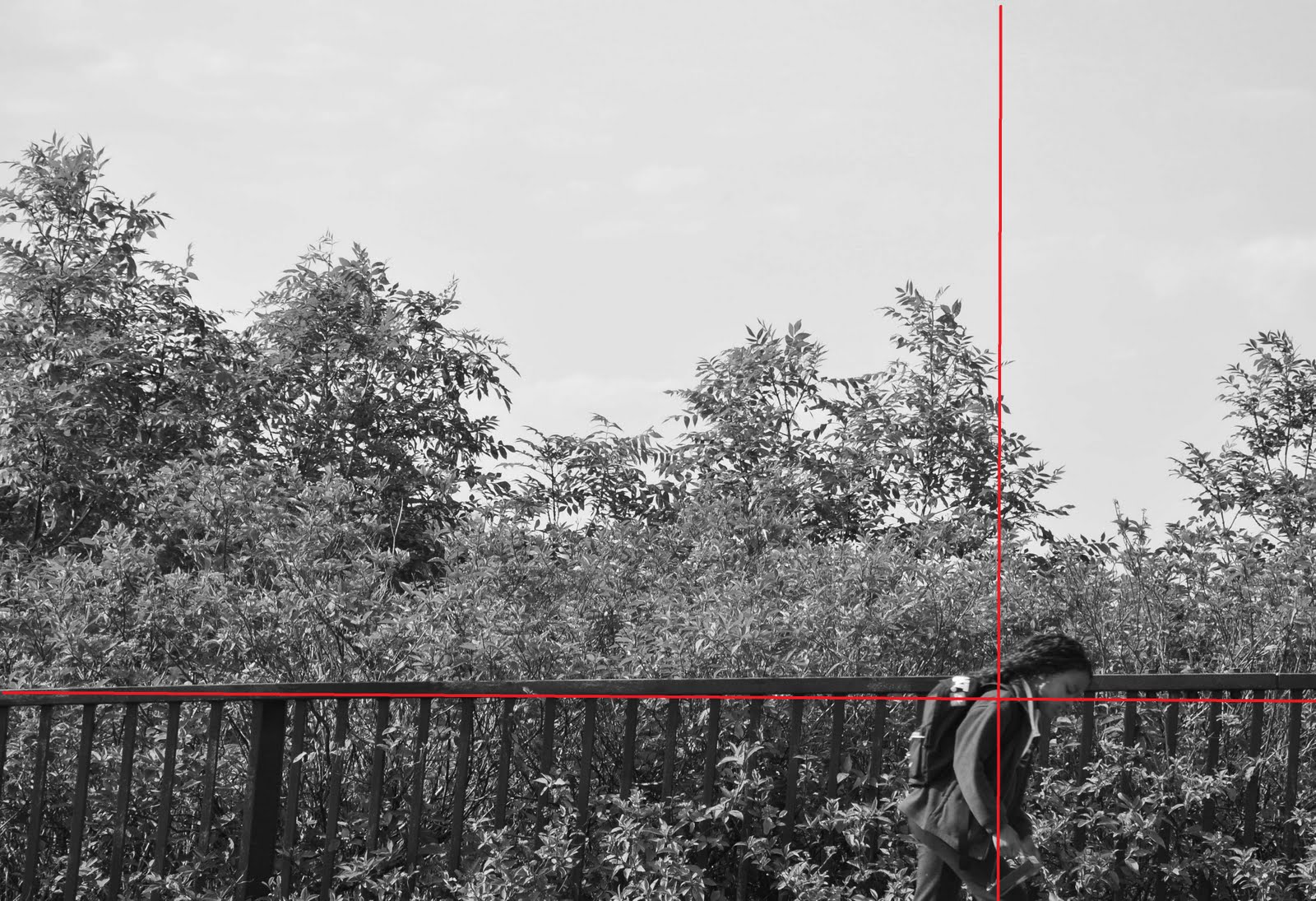
    This position nearest to the edge and bottom corner of the frame gives the greatest sense of movement as it can be implied that the subject has just walked through the empty space in the left hand side of the frame.  You also get the sense of urgency as she is just about to walk out of the frame.  If she was positioned in the centre you would be unsure of her direction and whether or not she was posing for the shot which would have given a more staged feel to the shot.  
The following shows where the points lie in the frame.